Showing posts with label Dr. Martin Luther King Jr.. Show all posts

Monday, January 19, 2015

Thank You Dr. King: A look at Selma


Last evening, I had the pleasure of going to see SELMA at the theater. The films is based on the 1965 Selma to Montgomery voting rights marches led by the Rev., Dr. Martin Luther King, Jr., James Bevel (played by Common), Hosea Williams, and John Lewis of SNCC. I thought that it was, overall, a good film. Historically, it seemed accurate and honest in its content - more than I've seen in previous films.
It was as expected, I thought. I also felt that David Oyelowo did an excellent job portraying the slain Civil Rights leader. Specifically, It tells the story of that very important and pivotal day in Civil Rights history. The film also addresses some important relationships in Dr. King's life such as the relationship with his wife, Coretta Scott King. It was not depicted, as in other films, as a smooth and always loving relationship. It explored the difficult times as well. Also, it dabbled in the relationship between King and President Lyndon Johnson as well as The Student Nonviolent Coordinating Committee (SNCC).

I've been indoctrinated and saturated with the life of the Rev., Dr. Martin Luther King, Jr. all of my life; so, this film was no revelation for me. Nonetheless, I still enjoyed watching. For some reason, I am drawn to any new depiction of Dr. King just like many others around the world. It never gets old. This is why this film is so important for younger generations or for people who don't know the history of the United States. It gives an explanation and perspective to the turmoil that is going on today here in the United States in places like Ferguson, Missouri (Michael Brown), Jena, Louisiana (Jena Six), New York City (Eric Garner) and many other places around the United States and the world. SELMA also reminds us that change can happen when people pull together as one.  It gives us hope and for that I am thankful. Go see the film if you can. It is worth your dime and all of your time. Thank you Dr. King. We love you.

Tuesday, April 16, 2013

Letter from Birmingham Jail

On April 16, 1963 Rev. Dr. Martin Luther King Jr  wrote a letter to the clergy of Birmingham, Alabama. He wrote this letter from the Birmingham Jail where he was held for 11 days.  Dr. King had been arrested 30 times prior to his death on April 4, 1968.

Saturday, January 14, 2012

Photo and Thought from MLK


"Rarely do we find men who willingly engage in hard, solid thinking. There is an almost universal quest for easy answers and half-baked solutions. Nothing pains some people more than having to think."  ~ Martin Luther King, Jr.


Friday, August 05, 2011

King and the Chicago Mob of 1966

Dr. Martin Luther King Jr’s march in Chicago was met with fierce opposition and violence.  Northern cities like Chicago had shown its true colors long before Dr. King arrived, but he would get to experience it first hand. 

On Friday, August 5, 1966, Martin Luther King Jr., Rev. Ralph Abernathy and others arrived in Chicago to protest housing discrimination in that city. Reverend Abernathy later reported that they received a worse reception than they had in the South. Their marches, especially the one through Marquette Park, were met by angry, screaming mobs of men and women who were throwing stones and bottles, while shouting curses and racial slurs. Read more…

Thursday, June 30, 2011

Mother King: In Memoriam


On June 30, 1974 Mrs. Alberta Williams King, mother of slain Civil Rights leader and activist, Rev. Dr. Martin Luther King, Jr., was shot and killed during a Sunday morning church service at Ebenezer Baptist Church in Atlanta, Ga. Mother King was at the organ playing “The Lord’s Prayer” when the shooting occurred. Deacon, Edward Boykin, was also killed in this violent attack.

The assailant, Marcus Wayne Chennault Jr., an African American from Dayton, Ohio, was later convicted and sentenced to death. That sentence was upheld for many years and later changed to life in prison at a state prison in Jackson, Georgia. On August 3, 1995, only two months after his sentence was changed to a life sentence, Chennault suffered a stroke, never regained consciousness and died. He was 44.  Although Mother King's death is rarely mentioned or remembered in the media, she must be remembered as not only a mother of one of the greatest leaders in the 20th Centurty, but for her supporting contribution to the civil rights struggle and the Kingdom of God.  Peace~

Sources: Blackfacts.org, Jet magazine, and The New York Times

Tuesday, May 04, 2010

Freedom Ride of 1961

On May 4, 1961 thirteen Freedom Riders began bus trip through the South to confront the injustices of Jim Crow and racism.  It turned out to be a trip they would never forget.

Do you want to ride or die?  Is it worth the trip?  Can they be that bad?  Those are the questions I imagine they asked on that spring day in 1961.  Yes, they saw the news reports, and heard testimonies in the training sessions that would prepare them for this trip south.  However, there is no experience like experiencing it for yourself:


Photo Sources:  NY Times, black past.org, and southern spaces.org

Tuesday, April 13, 2010

The King Memorial


In commemoration of the life and work of Dr. Martin Luther King, Jr., the National Memorial Project Foundation, Inc. is making efforts to build a King Memorial on the National Mall in Washington, D.C. The King Memorial will serve as a reminder that, in the words of King, “Every man must decided whether he will walk in the light of creative altruism or in the darkness of destructive selfishness.” It will remind America and the world that we are still working and fighting for a society that advocates freedom and justice for all.

However, all Americans and all who have shared “The Dream” must do this. Like the Civil Rights Movement that Dr. Martin Luther King, Jr. and many others fought to make a reality, it must be a collaborative effort from everyone.  Let us think about the future of this country, and about our children who must always know that there were champions of justice and equality. In fact, get them involved by visiting: kidsforking.org.  Also, please visit the King Memorial website to see how you can help make the King Memorial a reality.  Again, we must all help to “Build the Dream.” Peace~

Photo source:  NY Times

Thursday, January 15, 2009

Happy Birthday, MLK


Happy Birthday, Rev., Dr. Martin Luther King Jr. I would like to thank Deb S. for reminding me of this. I didn't remember until I went to visit her blog. She has a wonderful article. Check it out: Media By Sistrunk.

Friday, April 04, 2008

Poem 4: Wor(L)d Problem

Wor(L)d Problem


Let us imagine that the discontent in the Black community could be summed up like a word problem

Question: How many injustices would it take for one Black Nation to explode?

Answer:

2 Kings 2 Many
2 Kings 2 Many
By: Stephen Bess 1992


Monday, January 21, 2008

My Memory of Dr. Martin Luther King, Jr.


Before I knew who Martin Luther King, Jr. really was, I probably thought he was some sort of medical doctor or healer. I was a year old when he was murdered in Memphis, so my infant mind had no understanding of the times. I had no idea that DC had erupted upon the announcement of his death and Washington's innercity was on fire. When I became old enough to be interested in what my parents and grownups were discussing I heard them talking about someone named Dr. King. It sounded as if they knew him personally because they spoke of him with so much affection. They talked about all the things he had done to help black people and how he was a minister of peace. I heard words in reference to Dr. King that I didn’t understand like equality, justice, discrimination, segregation, integration, and assassination. I heard grownups talk about his Nobel Peace Prize; I didn’t understand what that was either, but I figured that it was something wonderful because it had the word “prize” in it.

My formal education of him began in school as a second grader at Washington Highland Elementary School (now Ferebee-Hope Elementary) in Southeast Washington, D.C. In school the teachers only talked about him around his birthday, but we would honor Dr. King and everyone in the struggle every day before school began. We began our school day with The Pledge of Allegiance and two songs, The Negro National Anthem and We Shall Overcome. By the time I was in the fourth grade I had memorized these songs in there entirety. Back then, the songs and times we talked about around Dr. King's birthday seemed so long ago, but by the time I’d reached the fourth grade Dr. King had only been deceased for eight years. Therefore, his words and memories were still fresh in the minds of the adults who taught me the Dr. King I grew to know. Now, like my parents before me I marvel at his dedication and command of the English language. I don’t know anyone today who can make freedom and equality sound so poetic and sweet. His words were and still are healing. The Bible talks about the power of words; it states, “Pleasant words are a honeycomb, sweet to the soul and healing to the bones” (Proverbs 16:24). In 2008 Dr. King still blesses us with his words (divinely inspired) which inspire us and give us hope. Let us keep his memory alive through grassroots activism and faith in God. Be inspired.
By the way, there are wonderful photos, videos, and information on Dr. Martin Luther King, Jr. and other figures in African American History on Columbia University’s newly launched Amistad Digital Resource. This wonderful website was launched on January 1, 2008 by professor and historian, Manning Marable and it is a great resource on the history of Africans in America. Also, I am proud to mention that my photo of poet, Sonia Sanchez was chosen for their Image Archive. So, I am officially a professional photographer and I don’t care what anyone says. *smile*


Today, I encourage you to visit the site and learn something new about the contributions given by Americans of African descent. Peace~
Sources: Southeast Missouri State University, negrospirtuals.com, homeofheroes.com, Amistad Digital Resource, Nobelprize.org, and The Holy Bible.
Photo sources: Columbia University and Channer.tv

Tuesday, January 01, 2008

Mahalia Jackson

The Lord's Prayer

Mahalia Jackson is the perfect way to start off the New Year. Tell me, who could sing the spirituals like Mama Mahalia? The mere sound of her voice takes you back to that old country church that your grandmother would attend. It's that church that sits far back from the road and there is a long dusty road that leads to it. There were no musicians in the church our grandmothers attended; there was just the humming of voices, the clapping of hands, the tapping of shoes on wooden floor panels, and a tambourine. I thank God for this "Black Pearl" from New Orleans, who sang songs that blessed the young, the old, and the souls of ancestors. Mahalia Jackson represents that old time religion that we need so desperately today. God bless Mahalia Jackson and God bless you in 2008. Peace~

Sources: Biblegateway.com and Wikipedia.org

Friday, May 18, 2007

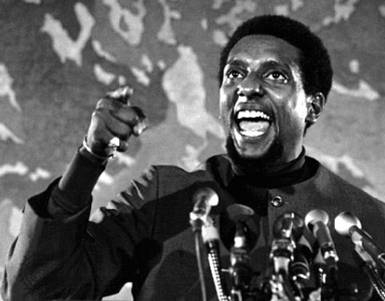
Stokely Carmichael Quote

Stokely Carmichael
[aka Kwame Toure 1941-1998]
Quote taken from Boogie Down Productions/Edutainment 1990


"History can never be made by one man, we must smash this one quickly. History is made only by the masses of the people, this is clear. Even a cursory glance at the fallacious presentation Of History by the American Capitalist system, will demonstrate just this. Take George Washington, as bad as he is... put him in the middle of Valley Forge, by himself, surrounded by the British, he can do nothing. Take Martin Luther King as righteous as he is... put him in the middle of Birmingham by himself, speaking out against racism, he would be lynched. But you take this same King, you take this same Washington put them in Valley Forge, put them in Alabama surround them with thousands of people who have the same ideas they do, willing to make those ideas reality and the situation changes drastically."

Photo and info source: sunyulster.edu and wikipedia.org
I was just feeling a little Edutainment by KRS-One and Boogie Down Production. It was one of my favorite cds from my college days in Savannah. I wish for you all a safe and wonderful weekend. Peace~


Wednesday, April 04, 2007

DC Riots of 1968

The corner of 14th and U Street in Northwest DC


The date was Thursday, April 4, 1968. It was time for change. If you were somewhere around the corner of 14th and U Street (Little Harlem) in Washington, D.C. things would’ve seemed normal. Unbeknownst to the people, it would become a transitional period in this nation’s history. It was early in the evening and there were people moving about. Black people. There were nurses, police officers, prostitutes, construction workers, pick-pockets, pimps, and preachers just carrying on like any other day. I often imagine that day even though I was just an eight month old baby living in Northeast Washington, D.C. with my parents.

I imagine a young black man walking down 14th Street that day in 1968. He's carrying a small transistor radio. The radio is playing Marvin Gaye and Tammi Terrell’s new hit, Ain’t nothing like the real thing. He seems to enjoy it as he smiles and pops his fingers to the melody. Suddenly, the song is interrupted and the disc jockey’s voice comes over the radio. He isn’t his usually exciting self. His tone is low-spirited and sad. The young man first stopped to see if anything was wrong with his new radio and then he heard the disc jockey announce that Dr. Martin Luther King, Jr. was shot and killed in Memphis. In disbelief, the young man stopped a woman on the sidewalk and asked if she'd heard about Dr. King! The woman's mouth fell opened as she placed her hand on her chest.
All around people began to stop all along the 14th and U Street corridor. They are all talking about the death of a King. It was felt all over the nation that day. In fact, the same thing was taking place in Baltimore City, 125th Street and Lenox Avenue in New York, 63rd Street and Cottage Grove in Chicago, and Third and McLeiuore in Memphis. The nation stopped. Again, it was a transitional period for the descendants of Africans in America. The cool and non-violent Negroes of the Dr. King era were quickly becoming volatile, hot, and Black!


Violence erupted in at least 110 US cities. The brunt of the rioting took place in predominantly black urban areas. The worst riots were felt in Chicago, Baltimore and Washington, D.C. The government ordered 22,000 federal troops and 34, 000 national guard to aid local police departments. The atmosphere was complete pandemonium. The Godfather of Soul, James Brown, appeared on national television to urge the people to not react in anger towards Dr. King's death. This did very little to put out the flames of change. Rioting continued throughout the weekend here in DC. By Sunday morning, 12 people were dead, 1,097 injured and over 6,100 were arrested. Additionally, at least 1,200 buildings were burned. 900 of those buildings were businesses. Damages were said to reach $27 million. The 1968 riots had a devastating affect on Washington's inner-city economy that can still be felt today. Nationally, state and local governments did very little to repair the damages in the largely affected/infected black areas. Many of the businesses did not return and urban decay set in. The date was April 4, 1968.


Photo credit and sources: The Progressive Review, the Smithsonian institution Research Information System, Scurlock Studios of Washington DC and Wikipedia

Books on Subject: Ten blocks from the White House: Anatomy of the Washington riots of 1968, Ben W. Gilbert, 1968
Hard Revolution,
George Pelecanos, 2004

Website: larryrosen.org

Artificial Intelligence Describing Morphological Confetti

AI  Photo and Overview As an educator, I have my reservations about the use of Artificial Intelligence (AI) but like most technological adva...