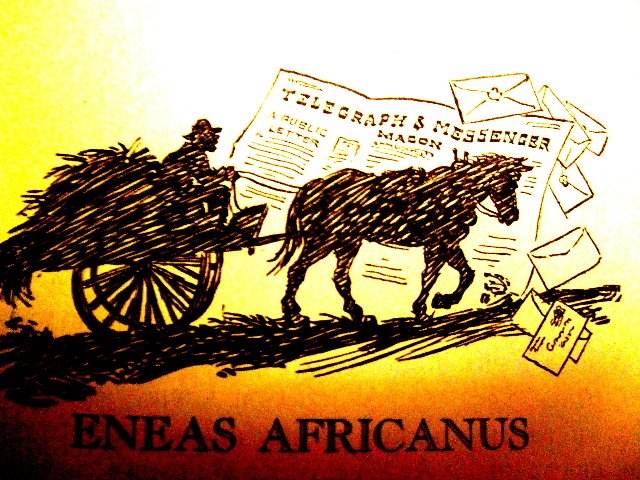
I recently picked up a book at the used bookstore near my job. I know…that’s nothing new for me, but this book was old and the title immediately caught my attention. The title of this book is,
Eneas Africanus, by Harry Stillwell Edwards. I said to myself, ‘what kind of animal is this about with a name like Eneas Africanus?’ I flipped through the book and read the dust jacket. I found out that this book is about a man. I immediately became interested enough to purchased the book for $2.00.
Author information:Favored Southern American author, Harry Stillwell Edwards, first wrote this as a series that ran in the Macon Evening News in Macon, Georgia (of which he was also part owner and co-editor). It was considered his most popular work. As a matter of fact, the series was so popular that it would eventually be published as a book in 1920; it sold over three million copies. Grosset & Dunlap, Inc. republished the edition that I have in 1940 and it became popular all over again in the North. 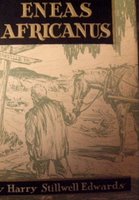
Now, Eneas Africanus is the story of a “devoted southern darky” named Eneas. Well, his full name was likely Eneas Tommey because Major George E Tommey owned him.
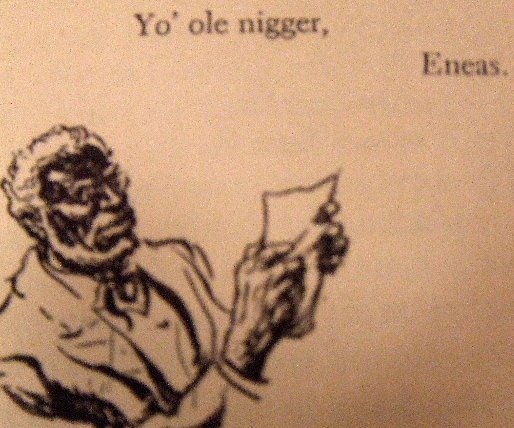
He was the Major’s favorite.He was a “vanishing type” who was true and faithful to his “white folks.” He was good “ol nigger Eneas.”
The year was 1864 and Federal Troops were closing in on Major Tommey’s stock farm and plantation. The major panicked because there was no one around to hide and relocate the family valuables and heirlooms. The troops had all retreated South to Jefferson County without any packages. So, the Major went to his trusted old Negro, Eneas. He gave Eneas specific instructions to take his valuables, Confederate money and a treasured heirlooms to the Tommey Home, located in Jefferson County. Eneas started his journey on a wagon equipped with an old flea bitten mare named, “Lady Chain,” a young pony called “Lightning” and a smile.
Eneas was a “vanishing type” who was true and faithful to his “white folks.”
Well, Eneas did vanish. This relatively short trip took Eneas on a journey that lasted for eight years. He traveled over 3350 miles and made connections with good “white folks” in at least seven states. How did that happen? You see, there were several counties in the south called Jefferson County. Eneas would ask for directions, but his inability to articulate where he was going took him everywhere else but ‘home.’ Eneas continued his journey throughout the South. He told everyone along the way about how wonderful ‘Marse’ Tommey was and how well he treated his slaves. He described a grand Plantation adorned with beautiful Oaks and luxurious fountains. They all felt that he was a lying “black rascal,” but likeable and humble. Somewhere along the journey Eneas was able to make some money from Major Tommey’s young pony. ‘Lightning’ was now a young racehorse and Eneas won races all across the South with him. He was also able to find a young mulatto wife in Alabama who joined him on his journey. They eventually had two children.
Well, It’s now October of 1872. The war is over and the slaves are “free.” Eneas was finally able to reconnect with his Master. They were both elated to see each other! Eneas told Major Tommey about his eight-year journey and all about the money that he made racing the horse. He also told the major all about his new young wife and two children. Naturally, Eneas offered Major Tommey all the money that he won racing and a lifetime of servitude by him and his new family. The Major told him to keep the money, because Eneas along with his wife and children were payment enough.
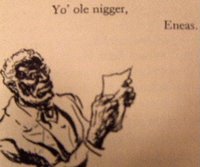
Eneas Africanus was a “vanishing type” who was true and faithful to his “white folks.” He was last of the good ol’ “southern darkies” or was he?